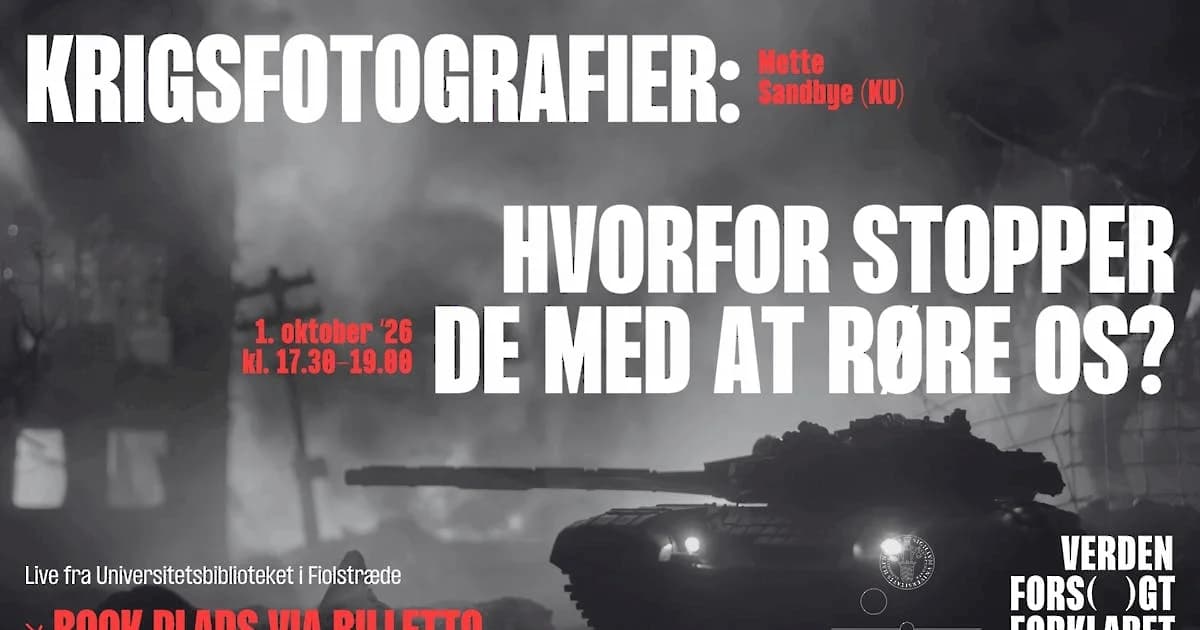
The war in Ukraine has now lasted nearly five years. In its early stages, images dominated the media front pages, and photographs from places such as Butja became central to our understanding of the conflict. But what happens to both the images and our engagement when a war continues without end?
The concept of image fatigue is often discussed: the idea that after many photographs of war and human suffering, we simply lose our reaction. However, cultural researcher Mette Sandbye challenges this explanation. She argues that it is not about becoming tired of images in themselves. Instead, the problem may be that the media repeats the same visual motifs over and over again.
Photography functions as a language according to Sandbye. Like any language medium, it can be repetitive and dull or rich and nuanced – it can repeat the familiar or open doors to new ways of experiencing the world. In her book Image Fatigue, she explores how war photography can evolve in line with the war itself.
Using concrete examples from Ukraine's media imagery – from the invasion period and photographs from Butja to later revisits and alternative perspectives on the experience of war – important questions are posed: Which images make us truly see something new? What does it mean when the media's visual expression becomes stagnant? And how can photography, as Sandbye suggests, create citizenship?
The event offers you a fresh perspective on the professional photographs you encounter daily – not merely as illustrations of events, but as a communication medium that actively shapes our worldview and understanding of conflicts far from our homeland.
About the speaker
Mette Sandbye is a professor in photography studies and modern culture at the Department of Arts and Cultural Sciences at the University of Copenhagen. Her book Image Fatigue is part of the series Challenges – Small Insights into Big Challenges from the Nordic Humanities Center. In 2025, Sandbye worked as a fellow on the research project In the Shadow of War: Denmark, the Nordic Region and the Return of Geopolitics.
Practical information
- Admission: 50 DKK
- Location: University Library, library building on Fiolstræde